Math
What is Math?
Math in K-12 is taught as a fairly standardized sequence, even across curricula that disagree on philosophy. The elementary years (K-5) cover counting, place value, the four operations on whole numbers, fractions, decimals, basic geometry, and measurement. Middle school (6-8) adds ratios, percent, negative numbers, pre-algebra, and an introduction to functions. High school typically runs algebra I, geometry, algebra II, and then either precalculus and calculus or statistics, depending on the student's path.
What makes math different from most subjects is how strictly cumulative it is. A student can read a Shakespeare play without having read Chaucer, but they can't do algebra without fluency in arithmetic and fractions. This is why a single weak year — especially in 3rd, 5th, or 7th grade — tends to echo for years afterward. Strong math education in the elementary years pays much higher dividends than catching up later.
How to Learn Math
The biggest mistake families make with math is treating it like every other subject — read the lesson, do the problems, move on. Math requires actual fluency, which only comes from practice that's both regular and slightly uncomfortable. A kid who can do today's lesson but couldn't do last month's needs to go back, not push forward.
A few principles that hold across grade levels:
- Conceptual understanding first, fluency second — but both matter, and you can't skip either
- Daily practice in short doses beats long sessions twice a week
- Word problems are not optional; they're how kids learn to recognize when to use what
- Manipulatives in elementary, paper and pencil through middle school, and calculators only when the concept is solid
Curriculum choice matters less than consistency. Saxon, Math Mammoth, Singapore, Beast Academy, AoPS, RightStart — all of them work when used regularly. None of them work when skipped.
Math Resources

Geometry: Seeing, Doing, Understanding
Harold Jacobs' classic high-school geometry course, built on discovery rather than memorized proofs. The one geometry text most veteran homeschoolers name first.

Sir Cumference and the Dragon of Pi
The picture book that gets elementary students to pi through a story rather than a formula. Reliable read-aloud for the circumference-and-diameter lesson.

Key to Geometry, Book 7: Perpendiculars and Parallels, Chords and Tangents, Circles
The seventh workbook in the compass-and-straightedge series that teaches geometry by construction. Self-paced, consumable, and unusually gentle on math-anxious students.

Key to Geometry, Book 4: Perpendiculars
A three-dollar consumable workbook that teaches perpendicular constructions with a compass and straightedge. One of the cheapest genuine geometry resources in print.

Geometry Workbook For Dummies
The practice half of the For Dummies geometry pair: several hundred problems with fully worked solutions, not just an answer key.

Geometry For Dummies
Mark Ryan's plain-English geometry reference, aimed squarely at the student who has a textbook and still cannot follow the proofs in it.
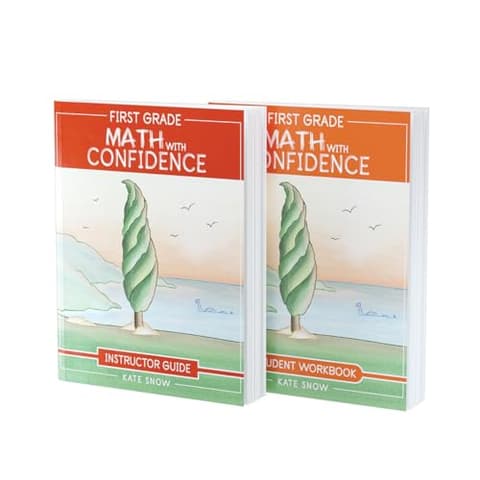
First Grade Math with Confidence Bundle: Instructor Guide & Student Workbook
Kate Snow's scripted, open-and-go first-grade math curriculum—a bundle of the Instructor Guide and Student Workbook that builds number sense through short, hands-on, conversational lessons. For 1st grade.

Evan-Moor Daily Word Problems, Grade 3
Daily 5-10 minute math word problem practice for 3rd graders covering all major math concepts through 36 weeks of real-world problems.

Spectrum Critical Thinking for Math, Grade 3
Math workbook focused on critical thinking and problem-solving strategies for 3rd graders, going beyond basic computation.

Spectrum Critical Thinking for Math, Grade 4
Advanced math problem-solving workbook for 4th graders emphasizing critical thinking, reasoning, and real-world applications.

Spectrum Test Prep, Grade 4
Standardized test preparation workbook for 4th graders with reading, math, and language arts practice plus test-taking strategies.

Spectrum Test Prep, Grade 3
Comprehensive standardized test preparation workbook for 3rd graders covering reading, math, and language arts with test-taking strategies.