Algebra
What is Algebra?
Algebra 1 is where math stops being mostly computation and starts being mostly reasoning. Students learn to represent unknown quantities with letters, manipulate expressions using the same rules they used with numbers, and solve equations and inequalities. Core topics include linear equations and graphing, systems of equations, exponents, polynomials, factoring, and an introduction to quadratics.
It's the hinge course in the standard sequence: pre-algebra comes before (negative numbers, order of operations, basic equation-solving), and geometry and Algebra 2 come after. Most state standards put it in 8th or 9th grade, though strong math kids often take it in 7th. Whatever path a kid is on in high school math, almost everything downstream — Algebra 2, trig, precalc, calculus, statistics, even chemistry and physics — assumes fluency with this material.
How to Learn Algebra
The hardest part of Algebra 1 is usually not the new ideas — it's the cumulative arithmetic. A kid who is shaky on fractions, signed numbers, or distributing a negative will hit a wall around the time equations get multi-step. Fix the arithmetic gaps first; don't push forward and hope.
What tends to work:
- A real textbook or structured course for the spine — algebra rewards working a lot of similar problems in a row, which apps and videos don't force.
- Short video explanations (Khan Academy, Math Antics) when a specific concept doesn't click — not as the main teacher.
- Graphing practice by hand before any graphing calculator. Kids who only ever see graphs on a screen don't build intuition for slope and intercepts.
A good gut-check: ask your kid to explain, out loud, why you can do the same operation to both sides of an equation. If they can, they get it. If they just recite steps, they're memorizing and it will collapse in Algebra 2.
Algebra Resources
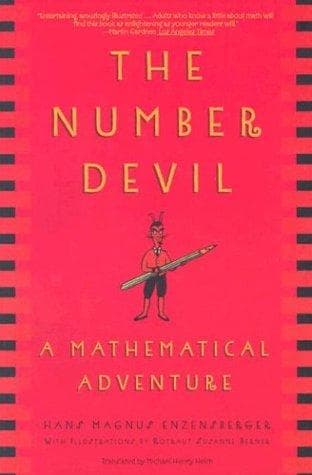
The Number Devil: A Mathematical Adventure
A captivating novel where a boy who hates math meets a number devil in his dreams, discovering the beauty of prime numbers, Fibonacci sequences, and other mathematical wonders.

Unknown Quantity: A Real and Imaginary History of Algebra
For curious nonmathematicians and armchair algebra buffs, John Derbyshire discovers the story behind the formulae, roots, and radicals. As he did so masterfully in Prime Obsession, Derbyshire brings the evolution of mathematical thinking to dramatic...

Life of Fred High School Set 1
This set can be started with any student who has completed Life of Fred Fractions, Decimals and Percents, PreAlgebra 1 with Biology, and PreAlgebra 2 with Economics or has completed a Pre-Algebra program in another curriculum and is good with word pr...

MyMathLab Algebra
MyMathLab Algebra 1 and Algebra 2 are two fully-digital programs by award-winning author Elayn Martin-Gay that provide parents with rich and flexible course materials that will engage your child. This personalized learning experience ensures your chi...
Algebra & Trigonometry
Algebra and Trigonometry provides a comprehensive and multi-layered exploration of algebraic principles. The text is suitable for a typical introductory algebra course, and wasdeveloped to be used flexibly. While the breadth of topics may go beyond w...
Algebra and Trigonometry
Algebra and Trigonometry provides a comprehensive exploration of algebraic principles and meets scope and sequence requirements for a typical introductory algebra and trigonometry course. The modular approach and the richness of content ensure that t...
Painless Algebra
Defines algebraic terms, shows how to avoid pitfalls in calculation, presents painless methods for understanding and graphing equations, and makes problem-solving fun. Titles in Barron's extensive Painless Series cover a wide range of subjects, as th...

Preply Online Math Tutors

Math Antics
Free, friendly video lessons that break down arithmetic, fractions, algebra, and geometry into clear step-by-step explanations - an approachable math teacher on demand.

GeoGebra
Free suite of interactive math tools - graphing, geometry, algebra, calculus, and statistics - that let students visualize and explore concepts hands-on in any browser or on any device.

StarSpark AI
An AI math teacher for grades 3–12 that coaches students through problems step by step — by typing, speaking, or writing on a canvas — with instant feedback. Standards-aligned, multilingual, and free to try.

CK-12 Algebra I FlexBook
Free, customizable Algebra I textbook covering equations, inequalities, functions, graphing, polynomials, and quadratics.