Fractions
What is Fractions?
Fractions are formally introduced in 3rd grade as parts of a whole and as points on a number line. Students learn to recognize unit fractions, compare fractions with the same numerator or denominator, and find equivalent fractions visually. Fourth grade extends this to comparing fractions with unlike denominators, adding and subtracting fractions with like denominators, and multiplying a fraction by a whole number. Fifth grade is the heavy year: adding and subtracting unlike denominators, multiplying fractions by fractions, and dividing with fractions.
By 6th grade, fractions are treated as a tool rather than a topic — they show up inside ratio problems, percent calculations, and the first algebraic equations. Anyone who isn't fluent by then will struggle, because the curriculum stops teaching fractions and just expects them. Fractions also become the building block for rational expressions in algebra II and trig identities in precalculus.
How to Learn Fractions
The reason fractions are hard is that they violate intuitions students built up in earlier grades. Multiplying makes things bigger — except when you multiply by a fraction less than one. Dividing makes things smaller — except when you divide by a fraction less than one. The numerator and denominator look like two separate numbers but behave like one. Symbols alone don't get this across. Models do.
The most reliable progression for teaching fractions:
- Concrete first: paper folding, pattern blocks, fraction circles, measuring cups
- Pictorial next: bar models and number lines drawn by hand
- Symbolic last: only once the student can predict what a problem's answer should look like before computing
The standard test of whether a kid truly gets fractions is asking them why dividing by 1/2 doubles a number. If they can show it with a picture, they understand fractions. If they only remember a rule, the topic isn't done yet.
Fractions Resources

Kumon Grade 5 Decimals & Fractions
Advanced decimals and fractions workbook for fifth graders covering mixed numbers, fraction multiplication/division, and decimal operations.

Kumon Grade 4 Decimals & Fractions
Introductory workbook for decimals and fractions using Kumon's incremental method, covering place value, equivalent fractions, and basic operations.
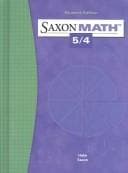
Saxon Math 5/4
A classic incremental math curriculum for grades 3-5 that builds mastery through daily practice, review, and gradual introduction of new concepts.

Full House: An Invitation to Fractions
Miss Bloom runs the Strawberry Inn, and she loves visitors. All through the day she welcomes a cast of hilarious characters until all the rooms are taken. It’s a full house! But in the middle of the night, Miss Bloom senses that something is amiss —...

Life of Fred: Fractions
After you know your addition and multiplication tables, you are ready for Life of Fred: Fractions. Fred will take you far beyond elementary knowledge of fractions so, even if you have had some basic training on how to divide up a pie so that you get...
Beginning Fractions & Decimals
Fun music, colorful animation, and lots of humor get kids excited and motivated to learn about fractions and decimals. Catchy songs and rhymes help students of all ages learn new terms and remember the rules about congruent parts, equivalent fraction...

CircuitMess Fractions & Decimals in Motion
A seven-lesson, fully student-led math course that teaches 4th and 5th graders fractions and decimals through story-driven sessions with no parent instruction required.

Fractions
Practice fractions skills on IXL, have fun, and win awards!...
ABCya 2nd Grade
Free educational second grade games and apps for kids.
ABCya 5th Grade
Free Educational Fifth Grade Games and Apps for Kids.

Math Charts
A free library of printable math reference charts: multiplication grids, times tables, hundreds and place value charts, and a 37-row fraction to decimal chart. PDF and PNG, no signup, no watermark.

Zlomko - Visual Fractions Practice
A free visual fractions and decimals trainer for ages 9-12. Short rounds cover parts of a whole, number lines, equivalence and comparison, with no account, no ads and no timer unless you want one.