Electronics
How to Learn Electronics
In its simplest form, learning electronics can be boiled down to four main objectives:
- Understand basic electronic components and how they work
- Understand how to read and interpret electronic schematics
- Be able to build and troubleshoot basic electronic circuits
- Have a working knowledge of electronic test equipment
Of course, there is a lot more to learn than just those four objectives, but they provide a good foundation nonetheless. Let's take a closer look at each one.
- Basic electronic components and how they work: This includes things like resistors, capacitors, inductors, diodes, and transistors. You need to understand what each component does, how it works, and what its limitations are.
- Reading and interpreting electronic schematics: This is a vital skill, as it allows you to understand how electronic circuits are supposed to work. It also comes in handy when you need to troubleshoot a circuit.
- Building and troubleshooting basic electronic circuits: This is where the rubber meets the road, so to speak. Once you understand the basics, you need to be able to put them to use by building circuits. And when something goes wrong, you need to be able to troubleshoot the problem.
- Working knowledge of electronic test equipment: This includes things like oscilloscopes, multimeters, and power supplies. Knowing how to use this equipment is essential for working with electronics.
If you want to learn electronics, you don't need to invest in a degree or take classes; you can learn on your own using books, websites, and videos. However, it's important to have a good foundation in basic concepts before moving on to more difficult topics.
Once you have a basic understanding of electronics, you can start experimenting with simple circuits and components. As you gain more experience, you can begin to build more complicated projects.
If you want to design and build your own electronics, you'll need to learn about circuit design and programming. These concepts can be learned through online courses, books, and videos.
Once you have a good understanding of electronics, you can start working on your own projects or join an electronics club or community to share your knowledge with others.
Electronics Resources

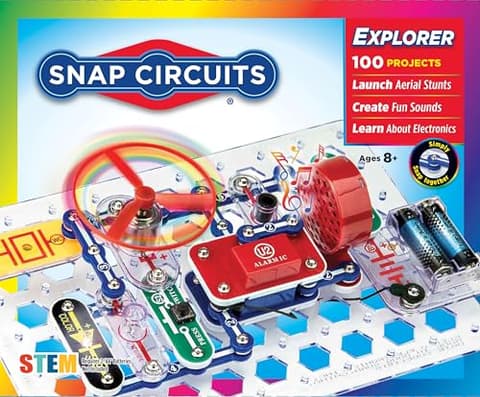
Snap Circuits Classic SC-300 Electronics Kit
A hands-on electronics exploration kit with over 300 projects that teaches kids about circuits, electricity, and engineering through snap-together components.
Snap Circuits Jr. SC-100 Electronics Exploration Kit
CircuitMess STEM Kits for Teens & Adults

CircuitMess STEM Toys for Kids

LAB:bit Educational Platform for BBC micro:bit
The LAB:bit is an all-in-one educational platform that introduces coding in the classroom. It's packed full of devices, LEDs, switches, sensors, and other programmable features.

Piper Make Starter Kit
Learn computational thinking, basic circuitry, and so much more
Snap Circuits SCL-175 Lights Electronics Exploration Kit
Hands-on introduction to electronics Make real working circuits and devices Make over 175 projects with over 55 colorcoded circuit components Plug in your in your iPhone or android phone or any MP3 player and see your ciruits react Snap Circuit...
Base Inventor Kit
The introductory Base Inventor Kit from littleBits includes everything creative kids need to turn their ideas into inventions! With a range of Bits that move, light up, and make noise, kids gain STEAM (Science, Technology, Engineering, Art, Mathemati...

CircuitMess Rimac Nevera Buildable RC Hypercar
A 1:28 scale, fully functional Rimac Nevera replica students build from the chassis up, then program in CircuitBlocks or C++ — an EV engineering course in kit form.

CircuitMess Jay-D 2.0 DIY DJ Mixer Kit
A buildable, fully functional DJ mixtable that teaches digital sound — DACs, amplifiers and speakers — alongside electronics assembly and coding.

CircuitMess Chatter 2.0 DIY Encrypted Communicators
Build a matched pair of long-range radio messengers that send encrypted texts with no Wi-Fi or cell service, and learn how wireless communication actually works.

CircuitMess Clockstar 2.0 DIY Smartwatch Kit
A wearable-tech kit: students assemble a working Bluetooth smartwatch, then code timers, custom button functions and gyroscope-driven games for it.