Language Arts Resources for 4th Grade
Fourth-grade language arts is the year writing becomes the hard part. Up to now most children have written a few sentences at a time; this year they are expected to plan and produce multi-paragraph pieces, and the jump catches a lot of families out.
It helps to treat language arts as four separate strands — writing, grammar, spelling, and reading comprehension — rather than one subject. They progress at different rates in the same child, and a strong reader with weak spelling is completely normal. Bundling them into one all-in-one program is convenient, but it can hide which strand actually needs the work.
Below are our picks, chosen to cover each strand, followed by the full fourth-grade collection. Our language arts curriculum guide compares complete programs across grades.
Our top 5 picks for 4th Grade language arts
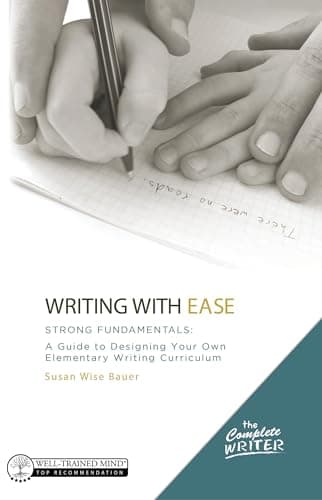
Writing with Ease: Strong Fundamentals
Susan Wise Bauer's method built on narration, copywork and dictation. Our first recommendation for a child who has plenty to say aloud but freezes when writing.
Spectrum Language Arts, Grade 4
Covers grammar, mechanics, usage and writing in one inexpensive workbook. A practical spine when you want the whole strand handled without assembling four programs.
Spectrum Reading Workbook, Grade 4
Reading comprehension with a strong nonfiction share, which is where fourth graders most often lose ground as textbooks get denser.
Spectrum Spelling Workbook, Grade 4
Spelling with proofreading and dictionary work rather than pure memorisation, so it transfers into a child's actual writing.
Epic! for Educators
A large free digital library. The cheapest way to solve the real driver of fourth-grade reading progress, which is volume — a child who reads widely gains vocabulary no workbook supplies.
What to expect in 4th Grade language arts
Expect multi-paragraph narrative, informative and opinion writing; parts of speech and sentence structure; commonly confused words and homophones; prefixes, suffixes and root words; summarising and drawing inferences from a text; and distinguishing fact from opinion.
The most common fourth-grade struggle is not grammar but getting started — the blank page. Narration, where a child tells you about something before writing it, remains the most reliable fix, and it is why classical programs lean on it so heavily. Talking the piece through first removes most of the paralysis.
Handwriting can also become a hidden bottleneck this year. If your child's ideas are good aloud but thin on paper, the physical act of writing may be the limit rather than composition skill. Letting them dictate occasionally will tell you quickly which it is.