The Best Learn-to-Code Sites in 2026 (Ranked by How Fast They Get You Job-Ready)
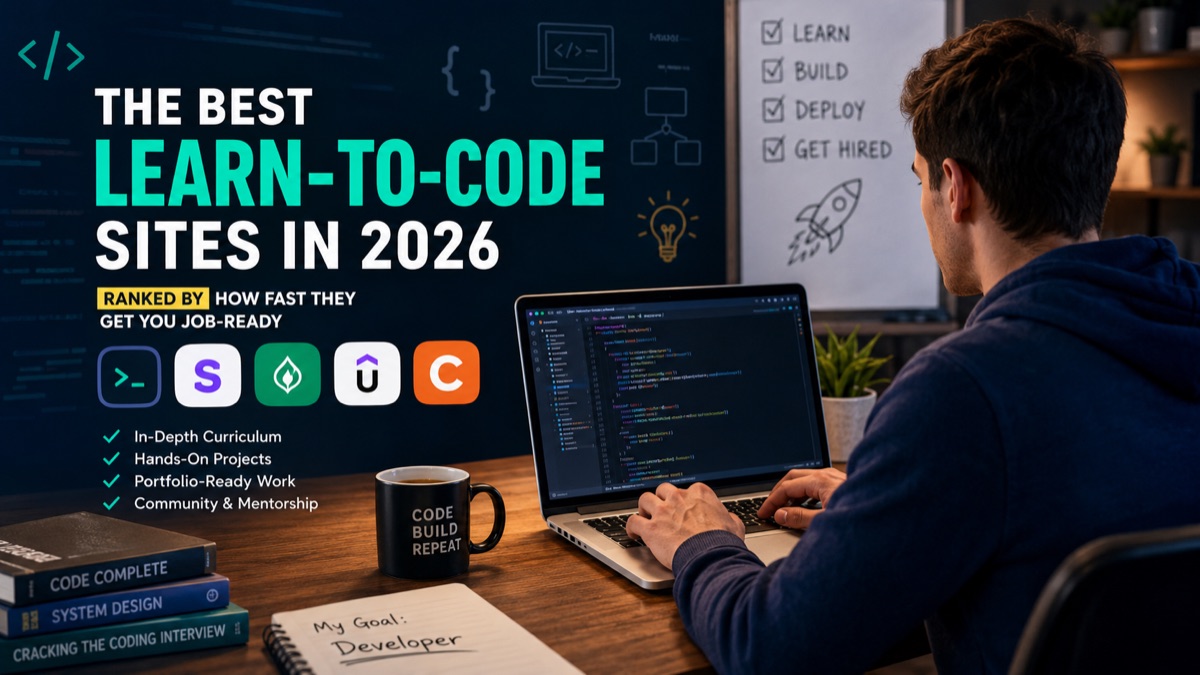
A few years ago, anyone could spend a weekend on a tutorial and walk away feeling like a programmer. The bar is higher now. Software developer roles are projected to jump through 2033, adding over 129,200 jobs, and the median salary sits at $133,080 – more than double the national median.
That means there’s a flood of eager career-switchers chasing a limited number of junior spots, and the ones who land jobs fastest are the ones who stop shopping and start building. The question isn’t which platform has the shiniest brand; it’s which one makes you employable before your savings run out.
We ranked five self-paced online platforms by a single, unforgiving metric: speed‑to‑job‑readiness. A realistic timeline in 2026 is 6 to 12 months of steady, focused effort, clocking roughly 1,000 to 2,000 hours of hands-on coding.
Overwhelmed by all the options?
We built a grade-by-grade planner that shows you exactly what to cover — and which resources match your style.
Download the planner →And the numbers show why that pace matters. Metana reports that 79% of bootcamp graduates land full‑time roles within 1 to 6 months, with an average first-job salary of $70,698 – a 51% bump over pre‑bootcamp income. Accelerate your skill‑to‑hire clock even a little, and you’re looking at months earlier income and tens of thousands of dollars in opportunity.
This ranking cuts through the marketing noise to show you which platform delivers the fastest return on your study time.
Methodology: How We Ranked These Platforms
Not all learning paths are built equal. Understanding how structured coding courses accelerate job-readiness starts with acknowledging that the best route today combines deep curriculum, relentless practice, genuine project work, and a support system that mirrors the way developers actually work.
According to the Stack Overflow 2025 survey, 69% of AI agent users agree AI agents have increased productivity, and 70% of agent users agree that agents have reduced the time spent on specific development tasks. So a platform that skimps on real coding reps or ignores AI‑assisted learning is already losing speed.
We evaluated each option on four equally weighted criteria, laser‑focused on the use case of a career-switcher with little or no prior experience who commits 20 to 40 hours a week with the goal of landing a junior developer role within 9 to 12 months.
- Curriculum Depth & Breadth – Does the path cover the languages, tools, and concepts employers actually ask for today: Python, JavaScript, SQL, Git, HTTP, and deployment fundamentals?
- Hands‑On Practice Ratio – How much of the learning experience is spent writing code versus reading or watching? We looked for mandatory coding challenges, lengthy project sequences, and browser‑based or local environments that force you to solve problems yourself.
- Portfolio Output – The number and complexity of real projects a learner can ship by the end of the curriculum, because employers want to see working apps, not certificates.
- Community & Mentorship Support – Access to peer groups, mentors, AI tutors, and job‑hunt resources like Discord servers, forums, and “Getting Hired” modules. Community keeps you moving when motivation dips, and that alone can shave weeks off your timeline.
The Top 5 Learn-to-Code Sites for Job Readiness
#1 – Boot.dev
Boot.dev is a deep, back‑end‑focused platform that wraps rigorous systems education in RPG‑style gamification. Its single‑path curriculum walks you through Python, Go, SQL, HTTP, Linux, Docker, and Git across thousands of2,090 active lessons, 4821 courses, and 159 projects – all designed to make you write code from day one.
The platform has logged over 3310.7 million total lesson completions, and an AI tutor named “Boots” uses the Socratic method to nudge you toward answers rather than handing them over.
That intentional struggle accelerates the kind of deep understanding that separates a back‑end developer from someone who just knows syntax.
- Unusual volume of deliberate practice. According to Boot.dev’s 2026 State of Learning report, Python lesson completions average roughly 22,000 per day, and 11.7% of all successful submissions are lesson resets – meaning learners actively revisit material until it sticks. That’s a level of repetition most self‑study paths never enforce.
- AI‑driven wrestling leads to mastery. The same report shows that learners genuinely struggle through concepts before peeking, which builds the mental models hiring managers test in technical interviews.
- Proven outcomes from a verified student. A Class Central review documented one learner who completed 14 courses and 8 projects over roughly a year of daily practice, reaching Level 108 (Archmage), and concluded, “In terms of knowledge, I should be able to get an entry‑level job as a back‑end dev.”
- Pricing & timeline that align with a year‑long plan. Pricing starts at $49 per month or $349 per year, and most beginners finish in about 12 months. For those on the annual plan, the total cost stays under $400 for the entire job-readiness period.CourseFacts confirms the backend path costs $59 per month or $399 per year, and most beginners finish in about 12 months. That keeps total cost under $400 for the entire job‑readiness window (annual membership at $399).
Best for career-switchers targeting back-end roles who thrive on gamified progress and are hungry for the thousand-plus hours of deliberate coding that hiring managers look for.
Less ideal if you’re leaning front-end, prefer video-heavy instruction, or tend to let a subscription lapse while you dabble – Reddit discussions on r/learnprogramming fairly note it can feel “expensive for passive learners” and its narrow back-end scope frustrates those still exploring specialties.
That said, if you’re all-in on becoming a back-end developer, the forced depth and constant coding make Boot.dev a strong path on this list.
#2 – Scrimba
Scrimba’s signature “scrim” format lets you press pause on a screencast and instantly edit the instructor’s code right in the browser, collapsing the space between watching and doing.
Its Fullstack Developer Path packs 108.4 hours of content and more than a dozen portfolio projects, with students reporting first developer jobs in as little as 4 to 11 months.
A 4.5/5 Trustpilot rating and a 75,000-member Discord community back up the retention and support that keep learners on track.
- Job-placement track record that’s hard to ignore. Based on Scrimba’s own 2026 course comparison, learners on the Fullstack path land roles within 4 to 11 months. The pipeline builds a diverse, employer-ready portfolio that spans front-end and back-end work.
- A tech stack that mirrors a real full-stack role. That same path covers HTML/CSS, JavaScript, React, Node.js, Express, SQL, Next.js, TypeScript, and AI engineering – all in one integrated curriculum. You won’t need to hop between platforms to pick up a missing piece.
- Affordable with instant feedback. Scrimba Pro costs $24.50/month on the annual plan ($294/year) (as of May 2026) and bakes in AI-powered Instant Feedback that catches mistakes in real time, which means you spend less time debugging trivial errors and more time internalizing patterns.
- A loud, helpful community. The Discord server of 75,000+ members provides code reviews, accountability buddies, and job-hunt camaraderie – exactly the kind of social pressure that prevents the “I’ll finish next week” doom loop.
Best for visual, interactive learners who want to touch real code seconds after seeing it explained, because the immediate feedback loop dramatically speeds up comprehension and debugging instincts.
Less ideal if your heart is set on deep back-end infrastructure or DevOps work, because Scrimba’s dedicated backend path sits at 39.4 hours and the AI Engineer path at just 11.4 hours – fine for flavor, but too shallow to stand alone.
If systems-level roles are your North Star, you’ll need to stack supplementary resources on top.
#3 – The Odin Project
The Odin Project is a free, open-source curriculum built around one counter-cultural idea: the fastest way to get job-ready is to suffer through real-world projects without training wheels. Its two full-stack paths – JavaScript and Ruby on Rails – throw you into cloning Facebook, building a restaurant page, and deploying to live environments from your own terminal.
By the end, you don’t just have a portfolio; you’ve learned to read documentation, set up a development environment, and debug without someone holding your hand – exactly the skills an interviewer pokes at.
- Two paths that each end with a job-search module. The Full Stack JavaScript path layers HTML, CSS, JavaScript, React, NodeJS, and PostgreSQL inside a progression that culminates in a dedicated “Getting Hired” course. The Ruby on Rails track mirrors that structure for back-end-leaning learners.
- Zero cost, maximum rigor. A verified testimonial on The Odin Project’s homepage reads, “Before I started… I had literally ZERO programming experience. After almost exactly a year … I was offered a job as a front-end developer.” That’s the same 12-month window we’re optimizing for, achieved with $0 spent.
- Community-driven, not instructor-driven. An active Discord server and open-source culture keep learners engaged via peer code reviews and accountability groups. The trade-off is that support is informal and asynchronous – nobody will chase you if you fall silent.
- Real-world tooling from the jump. You work in your own IDE, use Git and GitHub for version control, and deploy to hosting platforms, which means the terminal confidence and workflow muscle memory are baked in before you ever apply.
Best for self-driven learners who want CS-degree-adjacent rigor without tuition and who don’t flinch at a blank error log. The project-dense approach generates a genuine portfolio and teaches the independent problem-solving that often separates hired from still-applying.
Less ideal if you depend on AI tutor interactions, video walkthroughs, or quick feedback loops – the minimal guidance can feel isolating, and absolute beginners can lose days just wrestling with their local environment setup.
If that friction kills your momentum, you’ll move faster on a platform with more scaffolding.
#4 – freeCodeCamp
freeCodeCamp is the proof that your wallet doesn’t need to bleed for you to land a developer job. This nonprofit, text-only curriculum runs certification tracks, each requiring roughly 300 hours of work and five mandatory projects.
Over 40,000 graduates have turned that free curriculum into a paycheck, making it a notable launchpad in the self-taught developer world.
- Massive job-placement proof that rivals paid bootcamps. Scrimba’s course comparison highlights that freeCodeCamp has helped more than 40,000 people get jobs as developers – a number on par with some of the largest paid programs.
- A deep, no-cost curriculum. Those certifications span responsive web design, JavaScript, Python, data science, and data visualization, all delivered through browser-based challenges that force you to code every lesson. You won’t find a single video lecture, but you will write miles of code.
- Truly free, forever. No ads, no credit-card upsells, no “premium” tier. The lack of financial friction removes the biggest barrier for career-switchers who simply can’t risk hundreds of dollars on a gamble.
- Global community with local meetups. freeCodeCamp’s forum and thousands of local study groups provide an accountability network, though the quality of interaction varies wildly and there’s no real-time AI feedback to nudge you when you’re stuck.
Best for budget-conscious learners with titanium self-discipline who thrive on reading documentation and solving problems through code alone. The project-verified structure yields an honest portfolio that proves you can build, not just watch.
Less ideal if you lose steam without video explanations, gamified progress bars, or an AI tutor that can reframe a concept five different ways. The drier format can make dense topics like algorithms or back-end routing feel steeper, and you’ll piece together job-hunt resources on your own.
Still, if you can push through the occasional wall of text, the speed-to-hire math is hard to beat at zero dollars.
#5 – Codecademy
Codecademy’s polished, beginner-friendly interface and 13-language coverage make it an inviting on-ramp for someone who has never typed a curly brace.
With over 50 million learners and Pro plans at roughly $17.99/month billed annually (as of 2026) (Codecademy), it’s often the first name people mention. But when we measure by speed-to-job-readiness, the platform’s gentle hand-holding and browser-contained exercises become its limiting factor.
- Huge reach and the lowest possible friction for Day 1. The in-browser coding environment removes setup headaches, so you can type print(‘hello world’) within seconds of landing on the site. That accessibility is unmatched for absolute novices who need a confidence boost fast.
- Career paths that touch a wide tech stack. Codecademy offers guided Full-Stack, Back-End, Front-End, and Data Science tracks that introduce syntax and concepts across more than a dozen languages. Early on, the breadth feels empowering.
- Limited project depth that slows job readiness. Compared to The Odin Project’s clones or Boot.dev’s 9-project backend gauntlet, Codecademy’s capstone assignments tend to be more scaffolded and less complex, so you miss the messy integration and debugging struggles that mirror real sprints.
- Missing the real-world tooling employers expect. Codecademy's browser-based environment simplifies the initial setup and provides an integrated IDE, but it does include courses that teach Git and GitHub workflows.
Best for absolute beginners who want immediate, low-risk interactivity and a wide safety net of topics to sample before committing to a specialty. The gentle UX removes early frustration and builds just enough momentum to consider a deeper platform later.
Less ideal if you need to build a complex, full-stack portfolio in under a year – the sheltered exercises rarely force you to wrestle with environment quirks, version control, or unrehearsed bug fixes.
Those are the exact skills an interviewer will test, and Codecademy alone doesn’t build them fast enough.
Caveats & Counterpoints
A platform can compress the timeline, but it can’t control everything that affects your job hunt. Your learning pace, prior technical exposure, local hiring market, and ability to network all matter just as much as the curriculum.
Put bluntly, even the fastest-ranked platform here is not a guarantee without consistent, focused effort – the 1,000-to-2,000-hour benchmark still holds.
It’s also wise to keep the broader landscape in mind. A Scrimba analysis on learning paths found that while 53% of employers have officially removed degree requirements, fewer than 1 in 700 hires are actually affected by that policy – meaning a CS degree still opens doors that a portfolio alone might not.
And the Stack Overflow 2025 survey reveals that 66% of developers are frustrated by AI-generated “almost-right” code, a reality check that tools like Boots or Scrimba’s Instant Feedback can augment, but never replace, deep conceptual understanding.
Finally, that 79% bootcamp employment rate is encouraging, but roughly 1 in 5 graduates struggle, often because of relocation needs, weak soft skills, or a portfolio that doesn’t tell a coherent story. Speed matters, but so does picking a path you can sustain.
Conclusion
There’s no universal “best” platform, but filtering on speed-to-job-readiness strips away the fluff.
If you want deep back-end skills and a gamified progression that pushes you past 1,000 hours of deliberate coding, Boot.dev is a strong path. If you learn by touching code alongside a video and want a full-stack portfolio fast, Scrimba’s scrim format delivers. For those who crave the rigor of a project-heavy, “figure it out yourself” curriculum at zero cost, The Odin Project is a proven engine. And while freeCodeCamp and Codecademy may not top the speed charts, they remain solid launch points for specific learner profiles.
The fastest path to a developer job is the one you actually finish – so pick the style that matches your wiring, commit hard, build relentlessly, and lean on whatever community you can find. The timeline is real, the projects are waiting, and the only thing between you and that first pull request is the decision to start.
Learnamic Weekly Picks
Get handpicked learning resources, curriculum comparisons, and money-saving finds delivered to your inbox every week. Join thousands of homeschool families.
No spam, ever. Unsubscribe anytime.